| Instructor:
Dr.
Charles Camp
Office: EN 106B
Phone: 678-3169 (office)
Email: cvcamp@memphis.edu
Office hours: An "open door policy" or by appointment
Date: August 25, 2026
Hours Credit: 3 Semester Hours
Course Meetings: Lecture: Tuesday and Thursday;
1:00 - 1:55 pm, ET 302
Lab:
Tuesday: 2:40 - 5:40 pm, EN 114
Wednesday:
2:20 - 5:20 pm, EN 114
Thursday: 2:40 - 5:40 pm, EN 114
Required Textbook:
"Strategies for Creative Problem Solving" by Fogler, LeBlanc, and Rizzo -
Prentice Hall, 2014, ISBN-13: 978-0133091663
"Design & Control of Concrete Mixtures- Edition: 16th" - Portland Cement
Association, 2016, ISBN-13: 978-0893122775
Required Software:
| CATME |
Comprehensive Assessment of
Team Member Effectiveness (CATME)
is a web-based program designed for use
in higher education to promote SMARTER
Teamwork among teams. This software is
free. |
| Top Hat
|
Top Hat
helps create a learning environment
where every student can participate and
have a voice. Discounts
are available for the two-semester plan.
Join code is 223632. |
| Remind |
Remind
is a communication platform that helps
every student succeed. Whether you're in
the classroom, at home, or anywhere in
between, Remind makes it easy to stay
connected to your school community.
Join our class Remind page with code
@civ1101. |
Require Computer:
All students entering the Department of Civil Engineering must have a
laptop computer to use in their engineering classes and labs. The
laptop computer must be capable of connecting to the Internet via wireless and
running Microsoft Office. The Department of Civil Engineering is committed to education, and we
recognize computers as an extension of the learning tools needed to compete
professionally.
Course Description: Theory of measurements, linear measurements, angles, topographic
surveys, and mapping with applications in Civil Engineering: emphasis on individual and
group problem solving, techniques of data collection and analysis, and project
documentation.
Objectives
- To allow the student to become familiar with instrumentation and
measurements typical of those used in Civil Engineering practice.
- To understand the limitations, constraints, and
applicability of various field and laboratory data collection methods.
- To enhance the student's skill level in applying personal computers to
solve engineering problems and to develop material supporting engineering
decision-making and report presentation.
- To expand the student's understanding of the steps involved in design and engineering problem-solving.
- To increase the group problem-solving skills of the student.
Course Learning Outcomes
At the successful completion of this class, the student should be able to
demonstrate:
-
Recognize and apply basic instrumentation and measurements typical to those
used in Civil Engineering practice
-
Recognize the limitations, constraints, and applicability of various field
and laboratory data collection methods
-
Develop and apply spreadsheets to the solution of engineering problems
-
Application of problem-solving strategies to the analysis, design, and
evaluation of engineering problems
-
Write and present technical reports supporting engineering decision-making
-
Demonstrate the ability to work in a group
Course Outline
Weeks 1 - 5:
Field Measurements
- linear measurements and elevation measurements
Weeks 6 - 10:
Material Properties
- properties of concrete: proportioning, mixing, and testing of high-strength concrete
Weeks 11 - 15:
Fluid Flow and Filtration - filter material properties, fluid flow, and
filter performance
Grading
The final grades for the course will be based on the following
percentages:
|
Components |
Percentages |
|
Computational Homework |
10% |
|
Mid-term Exam |
20% |
|
Final Exam |
25% |
|
3 Group Projects |
45% |
IMPORTANT NOTE: Each student must
receive a passing grade (>70) on the homework and the exam portions of
their coursework. If a student has an overall passing grade for their complete
coursework and does not have a passing grade for their homework and exam
scores, they will not pass the class.
Final letter grades will be based on the following scale,
reflecting the percentages noted above.
|
Exam /
Homework / Projects |
Grade |
|
90 - 100 |
A |
|
87 - 89 |
B+ |
|
84 - 86 |
B |
|
80 - 83 |
B- |
|
77 - 79 |
C+ |
|
74 - 76 |
C |
|
70 - 73 |
C- |
|
60 - 69 |
D |
|
BELOW 60 |
F |
Attendance in both the lecture and lab portions of the class is required.
Every unexcused absence from a lecture reduces the final class average by 2%.
Every unexcused absence from a lab is a reduction of 25% on the student's grade
for the associated project report.
Make-Up Work
Due to the nature of the class, make-up work will be very
difficult to complete. If the student believes they should be allowed to make up
missed work or have an absence excused, they must document their reason(s) in
writing. The student will be required to submit documentation for missing the
class session and should be ready to provide such evidence when the request is
made. It will be up to the instructor's discretion if work may be made up or if
the absence is excused.
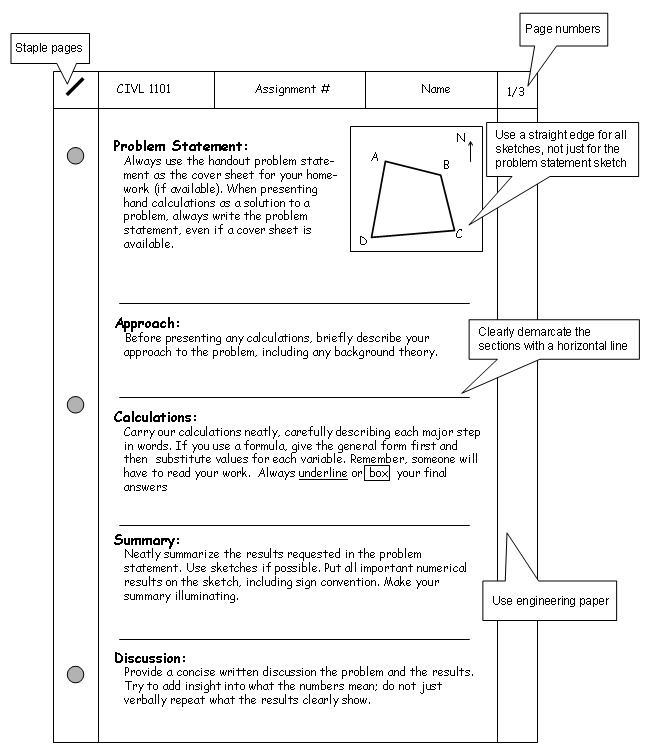
CIVL 1101 - Civil Engineering Analysis Homework Format
All assignments are to be submitted on engineering paper. You may use
any engineering paper as long as it has a background grid. The example page below
is for the paper available in the bookstore. If an alternate form of paper is used, the
headings at the top of the page should be modified to match the printed partitions;
however, the remainder of the instructions apply equally to either form.
Work should be done in pencil, using a lead hardness that produces
good contrast to the paper. Figures should be drawn with a straight edge and, if
appropriate, a circle template or compass. The layout and appearance of your work should
be of professional quality. Work on no more than one problem per page. Do not use the back of
a page for any reason. All pages should be ordered by page number and stapled. A good
guide for this standard is to prepare each assignment as if it were to be kept on file and
sent to prospective employers as an example of your work at the University of Memphis.
Homework is due at the beginning of class on the due date.
.
To account for a missed assignment, even with a valid excuse, one homework assignment will be dropped for
consideration in computing the homework average.
Academic Integrity
The University of Memphis expects all students
to behave honestly. The
Student Code of Rights and
Responsibilities
explains what constitutes a violation of our
Academic Integrity policy. Please see the Office
of Student Accountability's website for more
information:
https://www.memphis.edu/osa/. Plagiarism,
cheating, and other forms of academic dishonesty
are prohibited. Students who violate the
academic misconduct policy, either directly or
indirectly, through participation or assistance,
are immediately responsible to the instructor of
the class in addition to other possible
disciplinary sanctions which may be imposed
through the regular institutional disciplinary
procedures.
Examples of academic dishonesty include, but are
not limited to:
- Cheating – A student uses a smartphone
to access the internet while taking a quiz.
- Copyright infringement – A student uses
a photograph found on the internet in a
presentation without obtaining permission
from the photographer.
- Deception – A student gives a dishonest
excuse when asking for a deadline extension.
- Denying access to information or
material – A student makes library or shared
resource material unavailable to others by
deliberately misplacing those resources.
- Fabrication – A student invents data in
an academic work.
- Facilitating academic misconduct – A
student knowingly allows a portion of their
work to be used by another student.
- Plagiarism – A student represents the
ideas of another in a paper without citing
and referencing the work, or a student turns
in the same or nearly the same assignment
for credit in more than one class.
- Sabotage – A student prevents others
from completing their work by opening a
window to affect a temperature-controlled
experiment.
- Unauthorized collaboration – A student
works with other students on a paper without
the specific permission of the instructor.
Classroom Behavior
Students should be aware of the
Student Code of Rights and Responsibilities,
which describes examples of unacceptable
classroom behavior. Disruptive classroom
behavior will not be tolerated. Instructors are
empowered to remove students from class and
report behaviors for sanctioning to the Office of
Student Accountability.
Equity, Inclusion, and Accommodations
Our class respects all forms of diversity.
The University of Memphis embraces the diversity
of students, faculty, and staff, honors the
inherent dignity of each individual, and
welcomes their unique perspectives, behaviors,
and worldviews. In this course, people of all
races, religions, national origins, sexual
orientations, ethnicities, genders and gender
identities, cognitive, physical, and behavioral
abilities, socioeconomic backgrounds, regions,
immigrant statuses, military or veteran
statuses, size and/or shapes are strongly
encouraged to share their rich array of
perspectives and experiences. Course content and
campus discussions will heighten your awareness
of each other's individual and intersecting
identities. In accordance with
UofM Policy GE2004, the University will
ensure students receive consistent and fair
treatment and affirmation of the University's
commitment to diversity. The University
prohibits discrimination and harassment based on
protected characteristics as stated in
UofM Policy GE2030.
Please see the instructor if you need
accommodations for a disability or to fulfill
cultural or religious obligations. Students with
requests for accommodations should contact
Disability Resources for Students to
register and learn about the services available
to support their learning. Students with
disabilities are encouraged to speak with us
privately about academic and classroom
accommodations. It is strongly encouraged that
you register with Disability Resources for
Students (DRS) to determine appropriate academic
accommodations. Disability Resources for
Students is located in 110 Wilder Tower, their
phone number is (901) 678-2880 (V/TTY), their
email is
drs@memphis.edu, and their website is
https://www.memphis.edu/drs/. Disability
Resources for Students coordinates all
accommodations for students with disabilities.
Qualified students with disabilities will be
provided reasonable and necessary academic
accommodations if determined eligible by the
appropriate Disability Resources for Students
staff at the University. Prior to granting
disability accommodations in this course, the
instructor must receive written verification of
a student's eligibility for specific
accommodations from the Disability Resources for
Students staff at the University. It is the
student's responsibility to initiate contact
with the University's Disability Resources for
Students staff and to follow the established
procedures for having the accommodation notice
sent to the instructor.
Mental Health
As a student, you can sometimes feel
overwhelmed, lost, experience anxiety or
depression, and struggle with relationship
difficulties or diminished self-esteem. Mental
health challenges can interfere with optimal
academic performance. However, many of these
issues can be effectively addressed with some
help. If you find yourself struggling with your
mental or physical health this semester, please
feel free to approach me. I will try to be
flexible and accommodating. As your instructor,
I am not qualified to serve as a counselor, but
UofM offers confidential counseling services
on campus and via telehealth that are available
to students taking six or more credits at no
cost. UofM Counseling Center is staffed by
experienced, professional psychologists,
clinical social workers, and counselors, who are
attuned to the needs of college students. I
strongly encourage you to take advantage of this
valuable resource. To connect with Counseling
Center services, please visit 211 & 214 Wilder
Tower, or call 901.678.2068. To know more about
their services, you can visit their website at
https://www.memphis.edu/counseling.
For a mental health crisis that occurs
after-hours, please contact the Tiger Care Line
at 901.678.2068 and dial 2 to speak to a crisis
counselor. Remember, getting help is an
intelligent and courageous thing to do — for
yourself and for those who care about you.
Personal or academic challenges,
including food & housing insecurity
If you are experiencing personal or academic
challenges, including but not limited to food or
housing issues, family needs, or other
stressors, please visit the
Dean of Students Office to learn about
resources that can help. Any student who faces
personal challenges including, but not limited
to securing their food or housing and believes
this may affect their performance in the course
is urged to contact the
Dean
of Students Office at 901.678.2187 located
in the University Center, Suite 359 for
assistance. If you are comfortable doing so,
please also let the instructor know you are
experiencing challenges, as they may be able to
assist you in connecting with campus or
community supports.
Personal Relationships
There are special problems in any personal
relationship between individuals where one party
possesses direct academic, administrative,
supervisory, evaluative, counseling or
extracurricular authority over the other party.
Such positions include, but are not limited to,
teacher and student or assistant, supervisor and
employee, senior faculty and junior faculty,
mentor and trainee, advisor and advisee,
counselor and client, teaching assistant and
student, coach and athlete, and the individuals
who supervise the day-to-day student living
environment and student residents.
In accordance with
UofM Policy HR5050, no University employee
shall enter into or maintain any personal
relationships with students or with employees
over whom they exercise or, reasonably can
expect to exercise, direct or indirect control
in areas such as academics, administration,
supervision, evaluation, counseling, or
extracurricular authority or influence. No
University employee shall exercise any direct or
indirect control in the areas of academics,
administration, supervision, evaluation,
counseling, or extracurricular authority over any
student or employee with whom that employee had
previously been involved in a personal
relationship.
Any employee, including faculty, who is
currently in a personal relationship or becomes
involved in a personal relationship that might
be covered by the terms of this policy, must
disclose the relationship immediately to Human
Resources-Employee Relations and Engagement so
that any and all steps are taken to comply with
this policy.
Title IX
The University of Memphis prohibits and will
not tolerate sexual misconduct or gender-based
discrimination of any kind.
Sexual Misconduct & Gender-Based Discrimination
The University is obligated to investigate
sexual misconduct (including, but not limited to,
sexual assault, sexual harassment, stalking,
dating violence, and domestic violence). More
information about Sexual Misconduct can be found
in
UofM Policy GE2039.
Disclosure & Mandatory Reporting
If you disclose an incident of sexual
misconduct to a faculty member, they have an
obligation to report it to the University's
Title IX Coordinator. "Disclosure" may include
communication in-person, via email/phone/text
message, or through in-class/out-of-class assignments.
Confidential Resources
If you wish to speak confidentially about an
incident of sexual misconduct, please contact
the
University of Memphis Counseling Center
(901-678-2068), the
University of Memphis Student Health Center
(901-678-2287), or the
Memphis/Shelby County Shelby County Rape Crisis
Center (901-222-3950). If you would like to
learn more about sexual misconduct or report an
incident, please visit
https://www.memphis.edu/oie/.
Accommodations for Pregnant Students
Title IX prohibits the University from
discriminating against a student based on
pregnancy, childbirth, false pregnancy,
termination of pregnancy, or recovery from any
of these conditions. Title IX also prohibits a
school from applying any rule related to a
student's parental, family, or marital status
that treats students differently based on their
gender. Additional information can be found on
the Office for Institutional Equity website:
https://www.memphis.edu/oie/resources/.
This website was originally
developed by
Charles Camp for
CIVL
1101.
This site is
Maintained by the
Department of Civil Engineering
at the University of Memphis.
Your comments and questions are welcomed.
|


