|
"The more you read, the more you know. The more you know, the
more places you will go." - Dr. Seuss
Objective
This assignment aims to continue improving your spreadsheet skills,
experiment with visualizing large datasets, and develop a section of your
Project #1 report.
You must hand
in the coversheet for
the assignment, your calculations for Part 3, and printouts of your spreadsheets for
Parts 1 and 2. Also, submit your Word document
for Part 1 and the spreadsheet
for Part 2 to Canvas.
Part 1: Use WORD and the equation editor to develop a document that describes how the
capital and operations costs are computed for our prototype water treatment
system. Click on the following link to
download
a sample version of document.
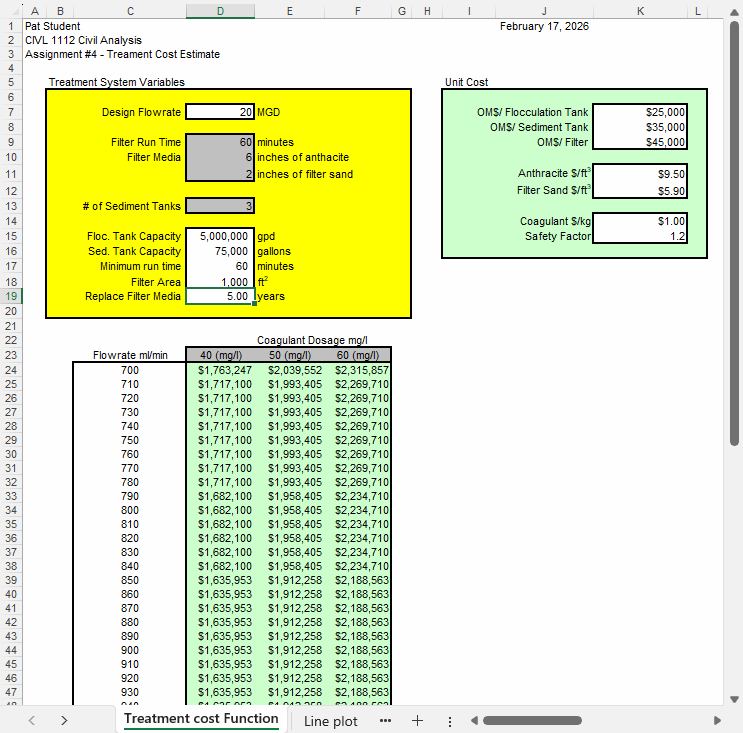
Part 2: Use Excel to create a spreadsheet where you can explore the relationship
between system flowrate (ml/min) and coagulant dosage (mg/l) as a function of
cost ($). Rewrite your treatment cost spreadsheet such that the entire cost
calculation is performed in one cell and develop a table of cost values for a
range of coagulant dosages and system flowrates. Develop a spreadsheet with the format shown below. Use the same values
shown in the spreadsheet for the variation of coagulant dosages and flowrates.
Hint: all green shaded cell contain formulas to
compute the the cost values. Click here for a blank template of the following
water treatment cost spreadsheet.
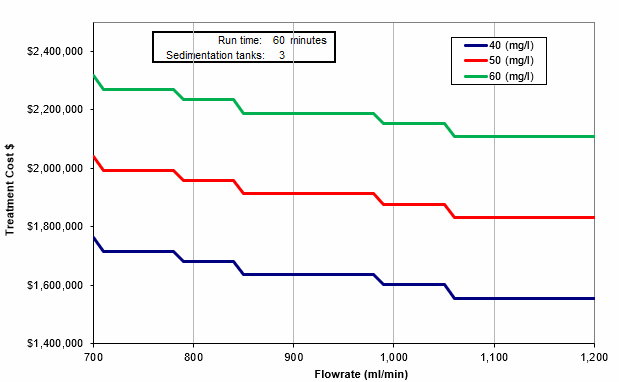
Use the data from this spreadsheet to plot the variation in treatment cost as
a function of flow rate and coagulant dosage. Your plot should follow this
format.
Part 3: Use the
ACI method for concrete mix
design to proportion a 1 yd.3 of concrete. Compute the weight of
each mix component by hand to meet the follow specifications:
The concrete is required for an interior
column. The 28-day compressive strength should be 6,000 psi. The slump should be between
1
and 2 in. and the maximum aggregate size should not exceed 1 in. The properties of the
materials are as follows:
- Cement: Type I, specific gravity = 3.15
- Coarse
Aggregate: Bulk specific gravity (SSD) = 2.65
absorption capacity = 0.5%
dry-rodded unit weight = 96 lb./ft.3
surface moisture = 0.5%
- Fine
Aggregate: Bulk specific gravity (SSD) = 2.60
absorption capacity = 1.1%
fineness modulus = 2.70
surface moisture = 1%
Follow the
homework format
given in class and report the weigh of cement, water, coarse aggregate, and
fine aggregate required per cubic yard for this application. If we
were to mix this concrete in the lab using the yellow mixer (about 1 ft3 in volume), what would be the required weigh of cement, water, coarse
aggregate, and fine aggregate?
Part 4. Read the Chapters
7 and 8 in the "A Mind for
Numbers" by Barbara Oakley.
Requirements
Your name and assignment number should appear in the top left corner of the
spreadsheet. The date should appear in the top right corner of the spreadsheet.
A web page describing the CIVL 1112
homework
policy is available. Read it before you turn in this assignment. You will be graded
throughout the semester according to the policy outlined in it.
Coversheet for homework
This website was originally
developed by
Charles Camp for
CIVL
1112.
This site is maintained by the
Department of Civil Engineering
at the University of Memphis.
Your comments and questions are welcomed.
|


