
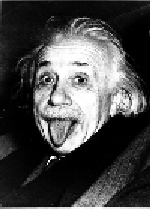
 The mere formulation of a problem is far more often essential than its
solution, which may be merely a matter of mathematical or experimental skill. To raise new
questions, new possibilities, to regard old problems from a new angle requires creative
imagination and marks real advances in science.
1. Collect and analyze information and data
2. Talk with people familiar with the problem
3. If at all possible, view the problem first hand
4. Confirm all findings
Don't jump to conclusion - Start with a open mind - Look at the big picture
 | Learn as much as you can |
| Determine what information is missing and what information is extraneous |
| The information should be properly organized, analyzed, and presented |
| Communicate using drawings, sketches, and graphs |
| Display numerical or quantitative data graphically |
The Case of the Dead Fish - Consider the case of a chemical plant that
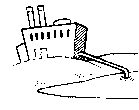
discharges waste into a stream that flows into a relatively wide river. Biologists
monitored the river as an ecosystem and reported the following data of the number of dead
fish in the river and the river level:
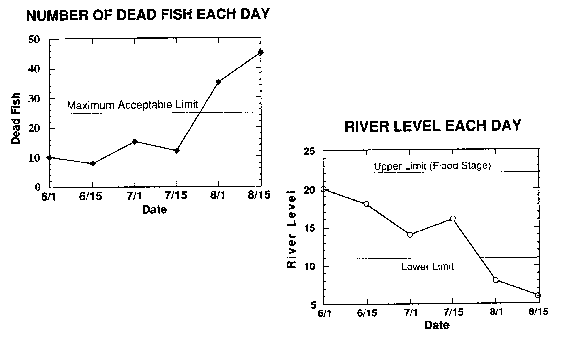
Graphs of the type shown above are called time plots and control
charts.
 The acceptable level
of dead fish was exceeded on August 1 and 15.
We discover that on July 29 there was a large amount of chemical waste discharged into the
river. Discharges of this size had not caused any problems in the past.
There has been little rain and the water level in the river was low on August 1
| Looking past the obvious |
| Challenging the basic premise |
| Asking for clarification when you do not understand something |
| Ask insightful questions |
Seeking Advice
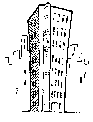 Here is a problem
encountered by a major hotel a number of years ago: this hotel had become very popular,
the elevators were very busy, and frequently caused backups in the lobby area.
Adding additional elevator shafts would require removal of a number of rooms and a
significant loss of income.
The doorman, overhearing their conversation, casually mentioned that it was too bad they
couldn't just add an elevator on the outside of the building
A great idea!
It occurred to the doorman because he was outside the building much of the time, and that
was his frame of reference.
 You can see a lot by
looking - Yogi Berra
| You should not rely on other people's interpretations of the situation or problem |
| Go inspect the problem yourself |
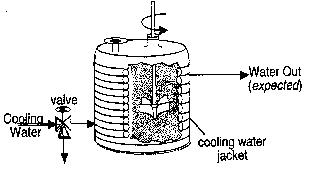 In the mid 1970s a
company completed a plant to produce a plastic product (PVC). The main piece of equipment
was a large reactor with a cooling jacket through which water passed to keep the reactor
cool.
When the plant was started up, the plastic was dark, nonuniform, and way off design
specifications.
The engineers in charge reviewed their design and refined their model and calculations. However, the problem did not change
Finally after many days, one of the engineers decided to look into the reactor. He found that a valve had been carelessly switched to the wrong position.
| Cross check and cross reference data, facts, and figures |
| Challenge assumptions and assertions |
Boxright had installed a new process for recovering and
recycling their "cooking" chemicals used in the paper making process.
After two years, the process had yet to operate correctly.
Courtland Construction was the supplier of the recycling equipment.
Courtland presented data and information from an article in the engineering literature
that they claimed proved Boxright was not operating the process correctly.
When Boxright analyzed this information in detail, it was stated that the data
would not be expected to apply to industrial-size equipment or processes.
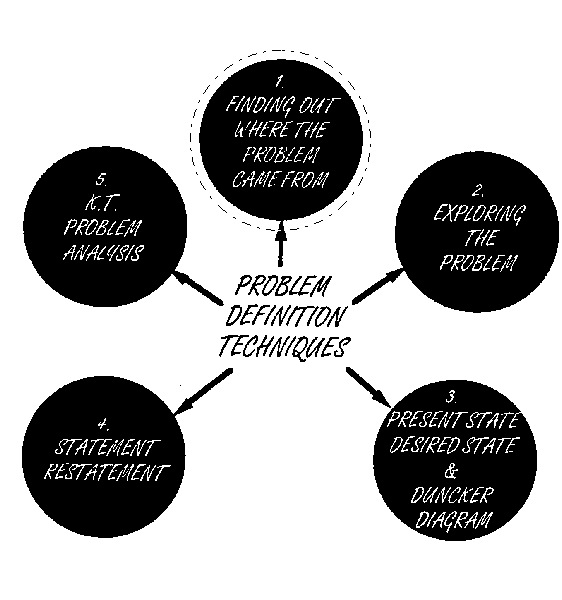
 Find
out where the problem statement came from
Never assume the problem statement is correct
| Where did the problem originate? |
| Who posed the problem statement in the first place? |
| Can that person explain the reasoning as to how they arrived at that particular problem statement? |
| Are the reasoning and assumptions valid? |
| Has that person considered the situation from a number of different viewpoints? |
| Have you used the first four steps to gather information about the problem? |
The Case of the
Dead Fish
The Situation: "Design a new waste treatment plant to reduce the toxic
waste from the chemical plant"
| Who
Posed the Problem? |
| Can
reasons for arriving at the problem statement be explained? |
| Are
the assumptions valid? |
| Has
sufficient data been collected? |
 Exploring
the Problem
Identify All Available Information
Recall or Learn Pertinent Theories and Fundamentals
Collect Missing Information
Solve a Simplified Version of the Problem to Obtain a "Ballpark" Answer
Hypothesize and Visualize What Could Be Wrong with the Current Situation
Brainstorm to Guess the Answer
Recall Past or Related Problems and Experiences
Describe or Sketch the Solution in a Qualitative Manner or Sketch Out a Pathway That Will Lead to the Solution
Collect More Data and Information
After Using Some or All of the Activities Above, Write a Concise Statement Defining the Real Problem
The Case of the
Dead Fish
Our engineer initiates his own investigation
| Identify Available Information - toxic discharge, river level low, large number of dead fish |
| Learn Fundamentals - call biologist about what could kill fish |
| Missing Information - a fungus in nearby lakes could kill fish, temperature was quite high, fish dead up and down the river |
| Hypothesis - Fish dying because of fungus not discharge |
| More Information - an examination of the fish concluded that they did die of a fungus not the discharge |
| Define the Problem - Identify ways to cure infected fish and prevent healthy fish from being infected |
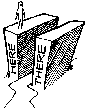 Present
State/Desired State
"You can't get there from here"
| Present State/Desired State - help us verbalize where we are and where we want to go. |
| Present State statement should match the Desired State statement |
| The Desired State should not contain solutions to problems that are not in the Present State |
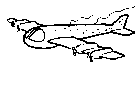 Hitting
'Em Where They Aren't
The Situation: "During WWII, a number of aircraft were shot down over Germany. Many of the planes that made it back safely to base were riddled with bullet and projectile holes."
Instructions: "Reinforce these damaged areas with thicker armor plating"
| Present State | Desired State |
| Many bullets penetrating aircraft | Fewer planes shot down |
| Many bullets penetrating aircraft | Fewer bullet holes |
| Many bullets penetrating aircraft | Fewer bullets penetrating in critical and noncritical areas critical areas |
The
Duncker Diagram
| The Duncker Diagram points out ways to solve the problem by making it OK not to reach the desired state. |
| There are two General Solutions: |
- Solutions that move from the present state to the desired state
- Solutions that modify the desired state until it conforms to the present state
| Functions Solutions are possible paths to the desired state |
| Specific Solutions implement the functional solutions |
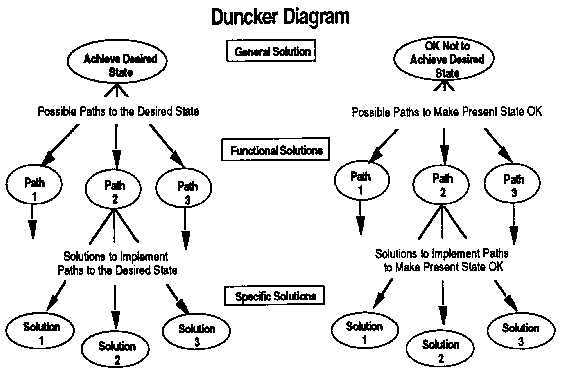
| Functional Solutions - What to do. |
| Specific Solutions - How to do it. |
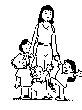 Kindergarten
Cop
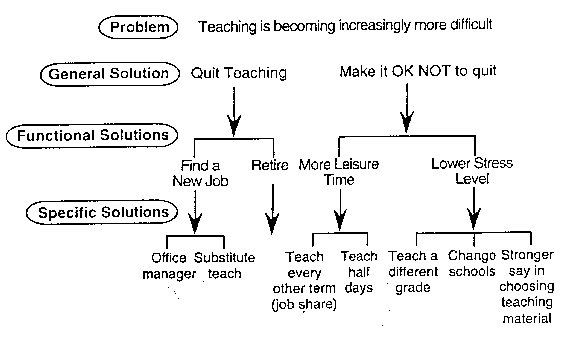
| The real problem was how to lower her stress at her workplace |
 To Market, To
Market
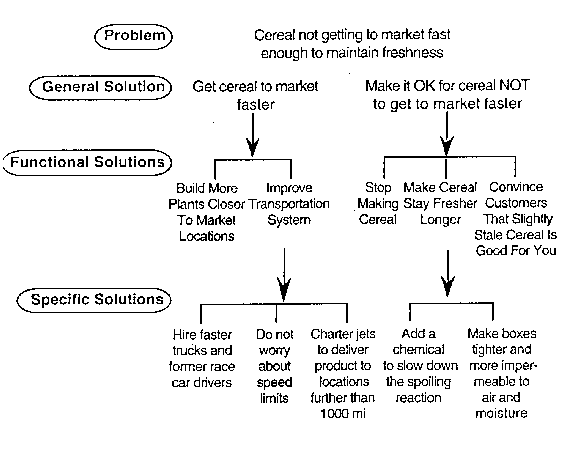
| The real problem is the cereal
was not staying fresh long enough |
Statement-Restatement
"A problem well-stated is a problem half solved"
| Similar to Present State/Desired State |
| Restating the problem is important to inject ideas |
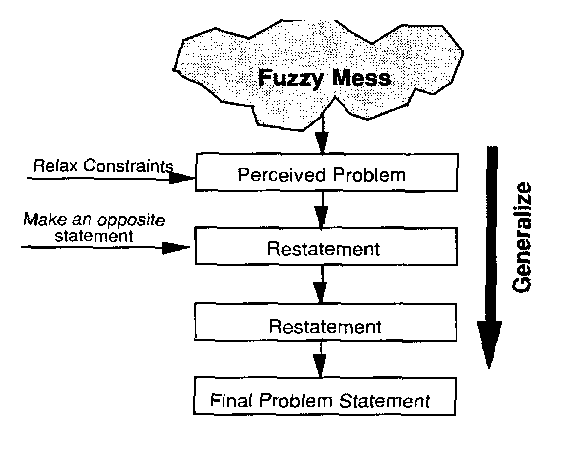
Problem Statement Triggers
Vary the stress pattern-try placing emphasis on different words and phrases.
Choose a term that has an explicit definition and substitute the explicit definition in each place that the term appears.
Make an opposite statement, change positives to negatives, and vice versa.
Change "every" to "some," "always" to "sometimes," "sometimes" to "never," and vice versa.
Replace "persuasive words" in the problem statement such as "obviously," "clearly," and "certainly" with the argument it is supposed to be replacing.
Express words in the form of an equation or picture, and vice versa.
To Market, To Market
Trigger 1
| Cereal not getting to market
fast enough to maintain freshness. (Do other products we have get there faster?) |
| Cereal not getting to market
fast enough to maintain freshness. (Can we make the distance/time shorter?) |
| Cereal not getting to market
fast enough to maintain freshness. (Can we distribute from a centralized location?) |
| Cereal not getting to market
fast enough to maintain freshness. (How can we keep cereal fresher, longer?) |
Trigger 2
| Breakfast food that comes in a
box is not getting to the place where it is sold fast enough to keep it from getting
stale. (Makes us think about the box and staleness... what changes might we make to the box to prevent staleness?) |
Trigger 3
| How can we find a way to get the cereal to market so slowly that it will never be fresh? (Makes us think about how long we have to maintain freshness and what controls it?) |
Trigger 4
| Cereal is not getting to
market fast enough to always maintain freshness. (This change opens new avenues of thought. Why isn't our cereal always fresh?) |
Trigger 5
| The problem statement implies
that we obviously want to get the cereal to market faster to maintain freshness. Thus, if we could speed up delivery freshness would be maintained. Maybe not! Maybe the store holds it too long. Maybe it's stale before it gets to the store. (This trigger helps us challenge implicit assumptions made in the problem statement.) |
Trigger 6
| Freshness is inversely
proportional to the time since the cereal was baked. Makes us think of other ways to attack the freshness problem. For example, what does the proportionality constant, k, depend upon? |
| Have all the pieces of the problem been identified? |
| Have all the constraints been identified? |
| What is missing from the problem definition? |
| What is extraneous to the problem definition? |
| Have you challenged the assumptions and information you were given to formulate the problem? |
| Have you distinguished fact from opinion? |
If you break the problem apart... be sure to put it back together
| The First Four Steps of Experienced Problem Solvers |
Collect and analyze information and data.
Talk with people familiar with the problem.
If at all possible, view the problem firsthand.
Confirm all findings.
| The Next Four Steps |
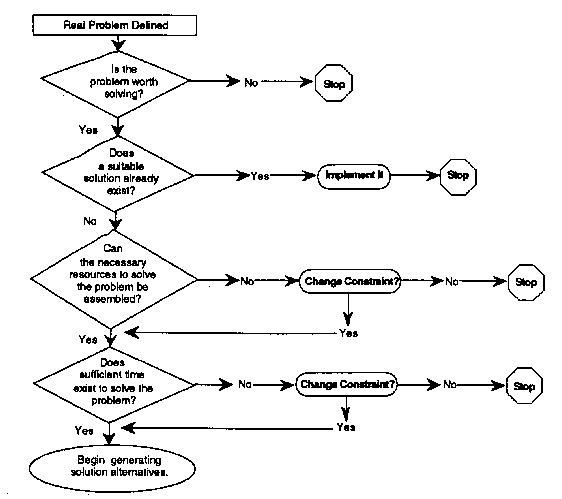
Determine if the problem should be solved.
Continue to gather information and search the literature.
Form simple hypotheses and quickly test them.
Brainstorm potential causes and solution alternatives.

| Develop criteria by which to judge the solution to the real solution |
| What are the resources available to solve problem? |
| How soon do you need a answer? |
| The quality of your solution is often related to the time and money you have to generate it and carry it through. |
Which Technique to Choose
A survey of over 400 problem solvers showed that the choices were divided equally among
those presented in this section
This web site was originally developed by Charles Camp for his CIVL 1101 class. This site is maintained by the Department of Civil Engineering at the University of Memphis. Your comments and questions are more than welcome.